Web
UX Research
Microsoft Ask Community
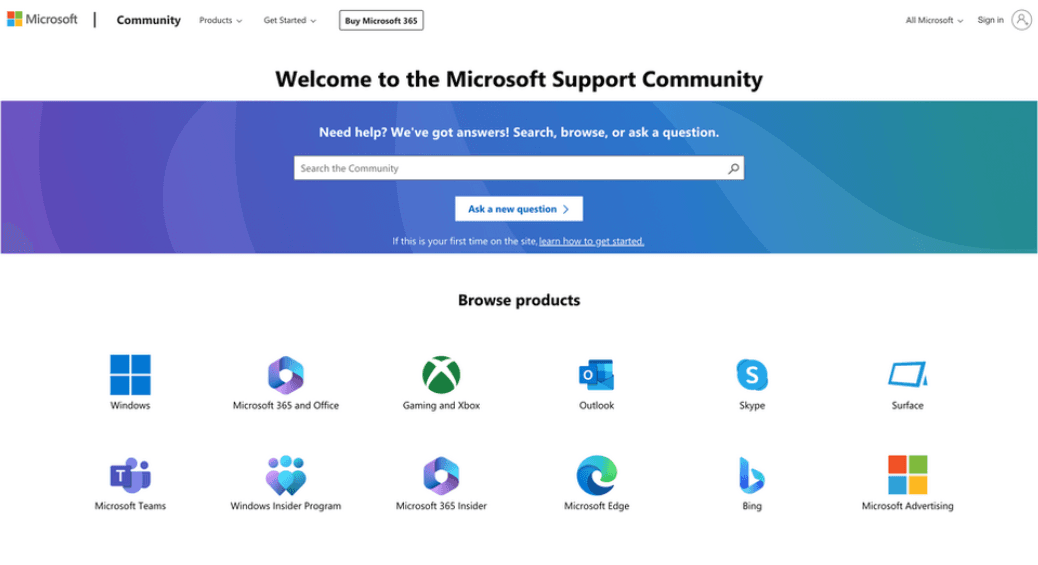
A Q&A community for Microsoft's products
Scroll down
to see more
"As a user, I want help for my issues with products"
"As a user, I want help for my issues with products"
UX Research, Consulting
Overview
Microsoft wanted to figure out how to improve the community experience of their Support Community. To achieve this, FeverBee offered a user research project to discover what was working and what needed improvement.
Client: Microsoft / Feverbee
Timeline: 3 months
Role: UX Researcher
Team: 1 Researcher, 1 Project Manager
Tools: Zoom, Docs, PowerPoint
Deliverables: Community Research Report



Research process
Process
Content
Research and Discovery
I took on the responsibility of conducting user research on their target user group from start to finish. First, I started with writing the script for the user studies. I used my standard method to do observational Think Aloud user interviews combining perceptions of the community experience and actual test runs on the community platform to complete common user scenarios. This way I could get a clear understanding of how they felt about the community and also saw how they used the community.
1
Research and Discovery
I took on the responsibility of conducting user research on their target user group from start to finish. First, I started with writing the script for the user studies. I used my standard method to do observational Think Aloud user interviews combining perceptions of the community experience and actual test runs on the community platform to complete common user scenarios. This way I could get a clear understanding of how they felt about the community and also saw how they used the community.
1
Research and Discovery
I took on the responsibility of conducting user research on their target user group from start to finish. First, I started with writing the script for the user studies. I used my standard method to do observational Think Aloud user interviews combining perceptions of the community experience and actual test runs on the community platform to complete common user scenarios. This way I could get a clear understanding of how they felt about the community and also saw how they used the community.
1
Method
Next, I moved ahead with executing the research. I utilised my own network and that of FeverBee to reach out to potential test users. After gathering enough participants, I scheduled the interviews and started the research. In the interviews I observed that some of the key functions of the community were difficult to find and participants struggled to complete the tasks. Some users would even resort to a search engine to figure out how to ask a question in the community, showing that finding the function was not obvious for users.
2
Method
Next, I moved ahead with executing the research. I utilised my own network and that of FeverBee to reach out to potential test users. After gathering enough participants, I scheduled the interviews and started the research. In the interviews I observed that some of the key functions of the community were difficult to find and participants struggled to complete the tasks. Some users would even resort to a search engine to figure out how to ask a question in the community, showing that finding the function was not obvious for users.
2


Results
After gathering all the interview data, I set out to create a report of the findings. Alongside the difficulty of finding the Ask Question function, users had difficulties searching for a specific question on the community page itself and would instead resort to using a search engine. While using search engines in favour of the internal search functions of communities is not terribly rare in real life, it highlighted that some of the users' first instinct was not to use the search function in the community platform. On the positive side, some users commended the minimal aesthetic on the community website.
3
Results
After gathering all the interview data, I set out to create a report of the findings. Alongside the difficulty of finding the Ask Question function, users had difficulties searching for a specific question on the community page itself and would instead resort to using a search engine. While using search engines in favour of the internal search functions of communities is not terribly rare in real life, it highlighted that some of the users' first instinct was not to use the search function in the community platform. On the positive side, some users commended the minimal aesthetic on the community website.
3

Outcome and Reflection
Microsoft’s team gave us stellar feedback for our work and were thankful for the insights we could provide for their community experience. For me personally, working on a project for Microsoft was a big win as it was easily the biggest client I worked with and I was delighted to hear they were grateful for the insights I could provide.
4
Outcome and Reflection
Microsoft’s team gave us stellar feedback for our work and were thankful for the insights we could provide for their community experience. For me personally, working on a project for Microsoft was a big win as it was easily the biggest client I worked with and I was delighted to hear they were grateful for the insights I could provide.
4
Outcome and Reflection
Microsoft’s team gave us stellar feedback for our work and were thankful for the insights we could provide for their community experience. For me personally, working on a project for Microsoft was a big win as it was easily the biggest client I worked with and I was delighted to hear they were grateful for the insights I could provide.
4